00 — Overview
TikTok Shop already has trust signals. The issue is synthesis, not absence.
TikTok Shop already shows ratings, reviews, seller badges, free returns, buyer protections, AI review summaries, post-purchase surveys, and support flows. Buyers are shown many signals — but they still have to connect them manually, often mid-scroll, mid-checkout, or after delivery.
Design opportunity
A lightweight Trust Layer that organizes existing and available signals into confidence at the moments buyers hesitate.
“TikTok Shop does not lack trust signals.
It asks buyers to assemble them manually.”
I designed a Trust Layer that turns scattered product, seller, creator, review, checkout, and post-purchase signals into decision-ready confidence moments.
The journey this project is designed around
01 — Context
A company-scale problem, not a UI detail.
Traditional e-commerce starts with intent. Creator commerce starts with interruption.
A shopper may not intend to buy. A creator video creates desire first — then the shopper has to evaluate product quality, seller reliability, creator credibility, shipping, returns, and reviews in seconds, not minutes.
$15.82B in US sales in 2025
TikTok Shop grew 108% year-over-year, reaching an 18.2% share of US social commerce.
Source: EMARKETER, Dec 2025
$87.02B US social commerce market
EMARKETER projects US social commerce to pass $100B in 2026 — platform-scale, not a trend-deck topic.
Source: EMARKETER, Dec 2025
$71B spent on social-media impulse buys
57% of those impulse buyers regretted at least one purchase made in the past year.
Source: Bankrate, 2023
55% of social shoppers regret a recent impulse purchase
Social commerce purchases drive measurable regret and returns friction industry-wide.
Source: SimplicityDX, State of Social Commerce 2024
70% feel deceived by undisclosed partnerships
Consumers report feeling deceived or negative when a paid or gifted creator partnership isn’t disclosed.
Source: BBB Influencer Trust Index, 2025
AI-assisted review synthesis is already emerging in commerce — a pattern this project builds on, not invents. Source: About Amazon, AI-generated review highlights, 2024
Two different starting points
Traditional E-Commerce
—Intent-driven
—Search first
—Evaluation expected
—Reviews and policies are part of the journey
Creator-Led Commerce
✓Discovery-driven
✓Video first
✓Evaluation is compressed
✓Trust has to catch up to desire
TikTok Shop already has safety and trust infrastructure. The opportunity is surfacing the right signals more clearly at the highest-friction decision moments — not implying the platform is unsafe.
Trust Gap
The trust problem is not missing information. It is scattered information.
Where trust signals already live today
Creator video
Product tag
Creator disclosure
Social proof
Product page
Rating
Review count
Seller badge
Sold count
Price
Reviews
Verified purchase labels
Incentivized review labels
AI summaries (some products)
Checkout
Shipping
Returns
Payment security
TikTok Shop protections
Post-purchase
Order status
Survey
Review prompt
Refund support
What the buyer has to figure out alone
—Is this product worth opening?
—Is this seller reliable?
—What do reviews actually say?
—Is this creator recommendation transparent?
—What protects this specific order?
—Did the product match the video?
“The buyer is shown many signals, but still has to connect them.”
Current
Scattered signals across the journey.
Trust Layer
Decision-ready confidence at moments of hesitation.
02 — Product Teardown
Method — a 60–90 minute manual walkthrough of TikTok Shop, anchored to one product for design realism: a pair of linen pants discovered through a creator’s outfit video.
Five moments in the journey. Five trust questions left unanswered.
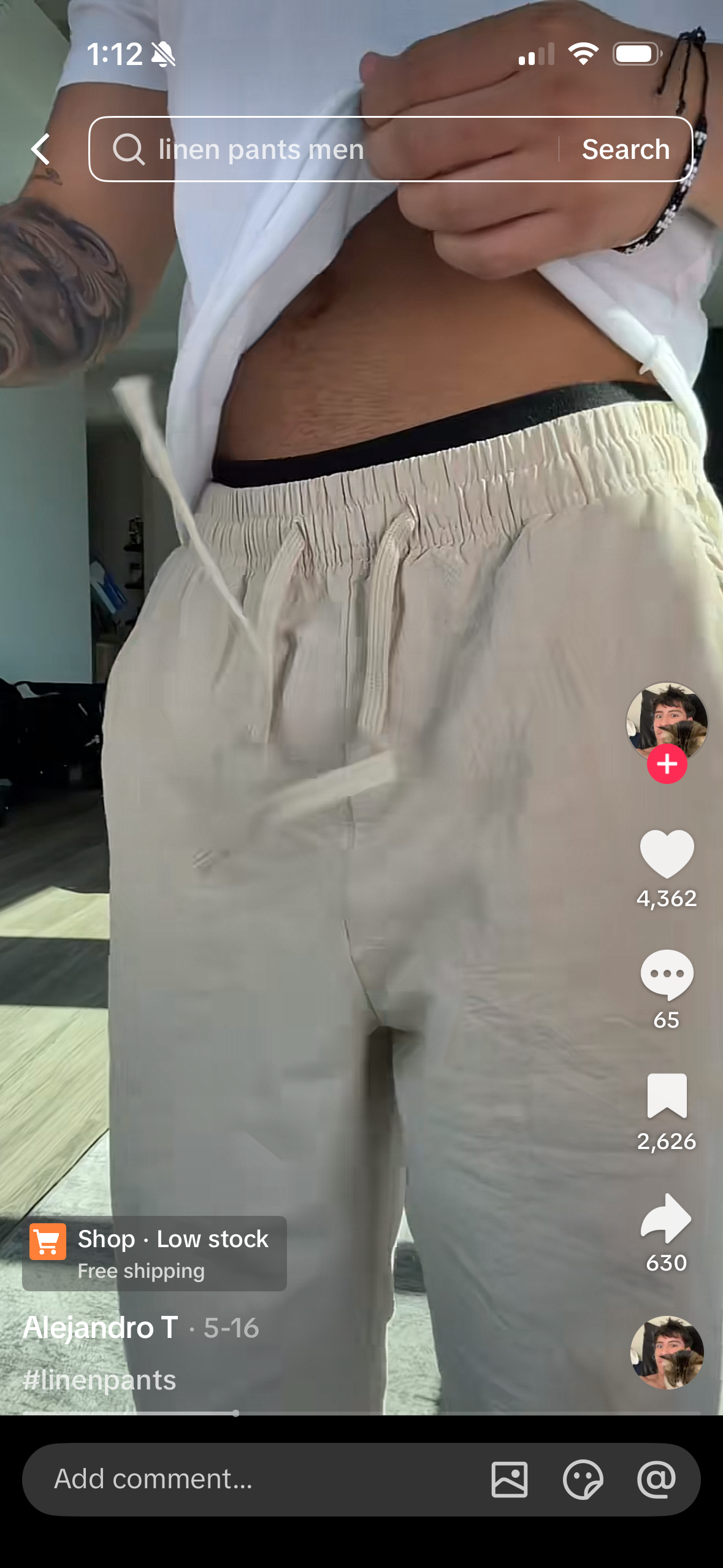
01Creator Video / FYP Discovery
What exists now
Creator-led UGC, product tag, commission disclosure, social proof, likes/comments/saves.
Trust gap
The video creates desire before the buyer sees enough evidence to evaluate the product.
Design opportunity
Add a lightweight trust preview that helps users decide whether the product is worth opening.
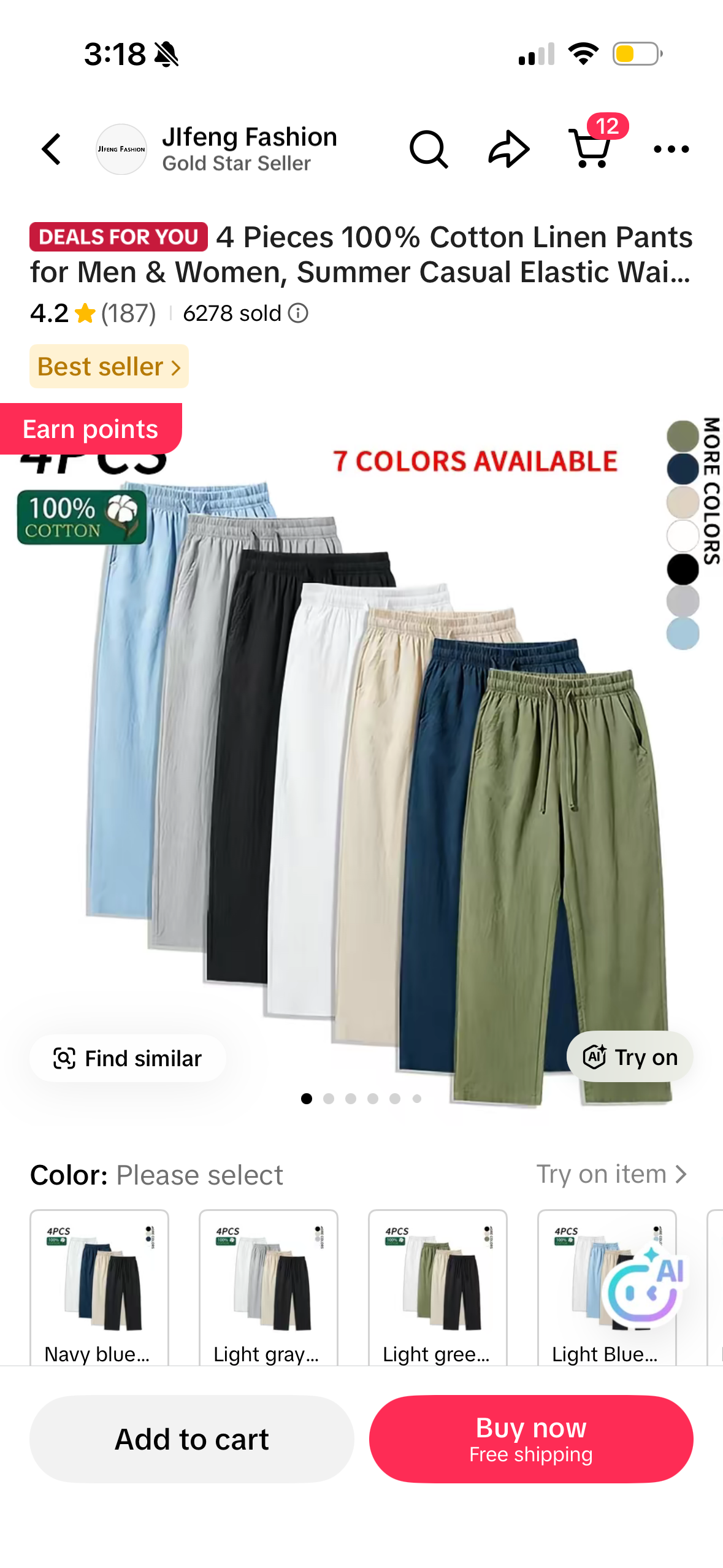
02Product Detail Page
What exists now
Ratings, review count, sold count, seller badge, shipping, returns, product details.
Trust gap
Signals are useful but distributed across the page.
Design opportunity
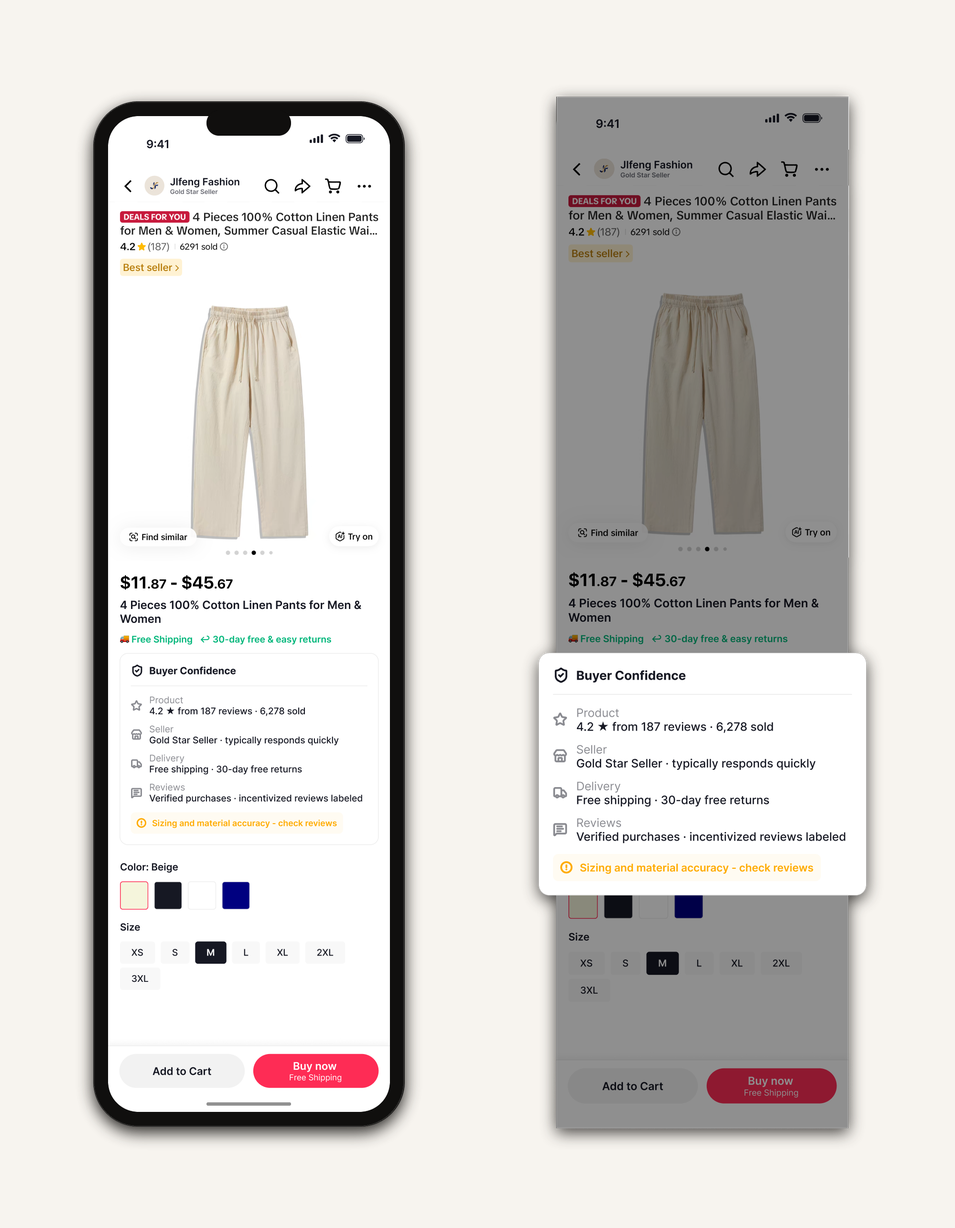
Add a Buyer Confidence module that synthesizes product, seller, review, shipping, and return signals.
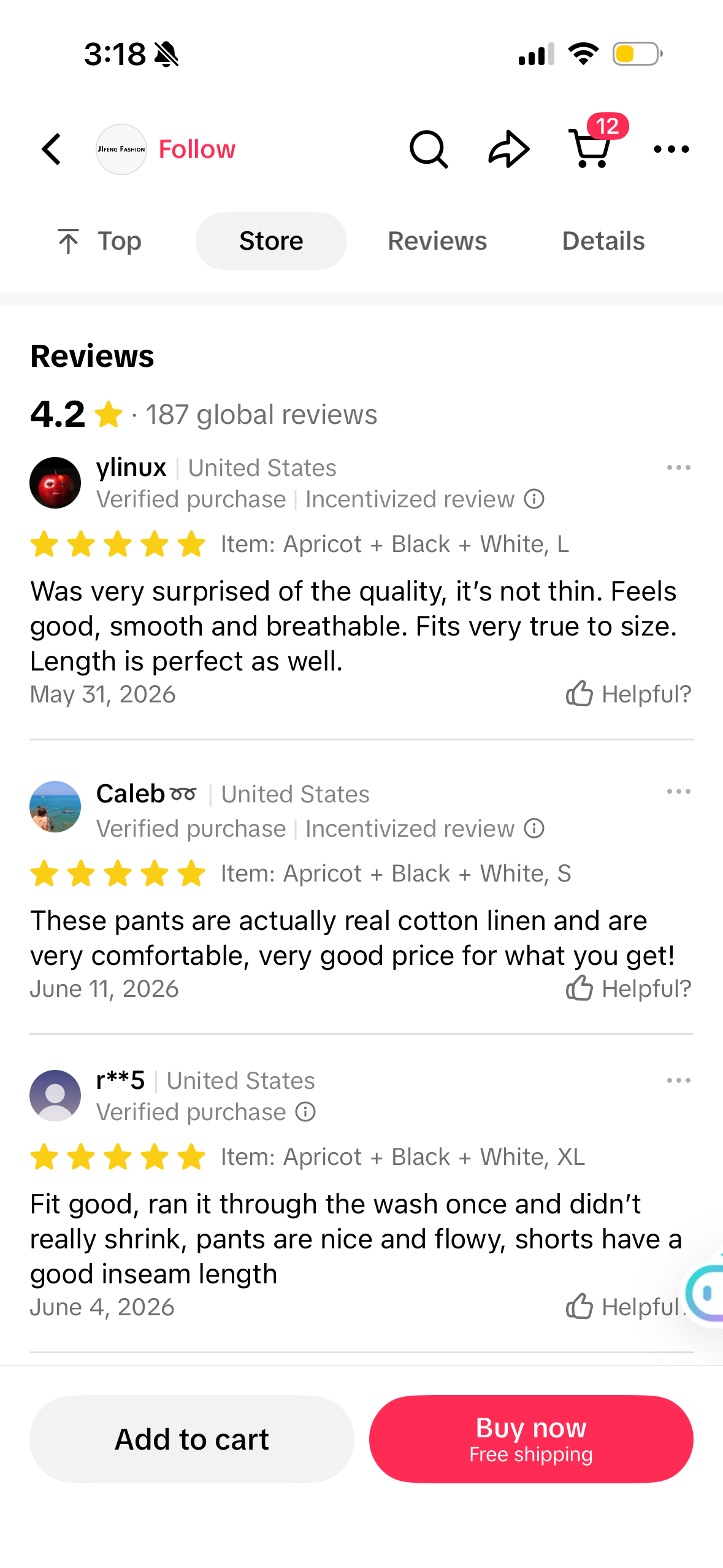
03Reviews
What exists now
Verified purchases, incentivized review labels, individual reviews, and AI-generated summaries on some products.
Trust gap
Review summaries can be inconsistent and may lean positive; buyers still need balanced tradeoff information.
Design opportunity
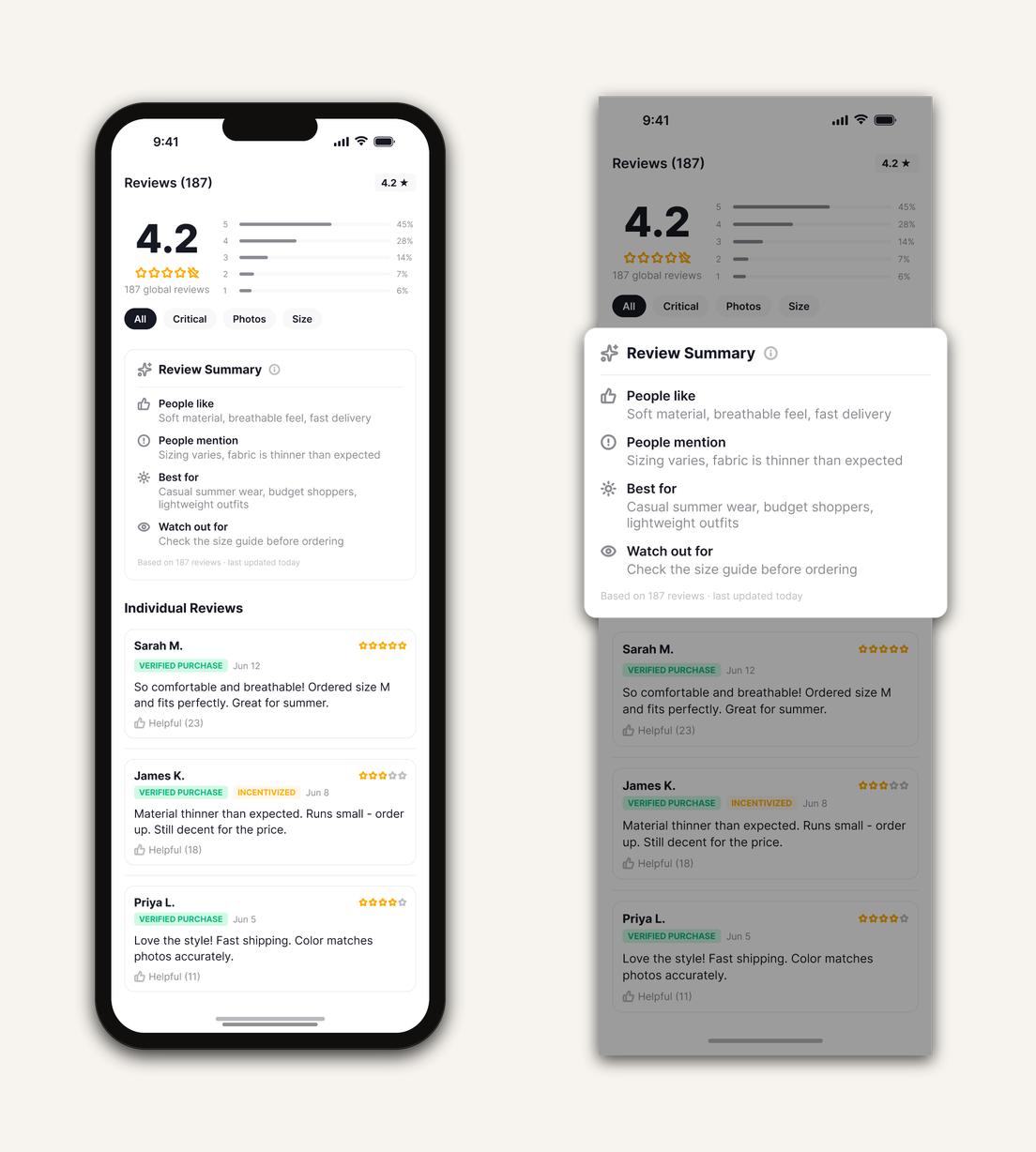
Upgrade review synthesis with positives, concerns, best-fit, watch-outs, and source count.
04Checkout
What exists now
Payment security, shipping, order summary, TikTok Shop protections, Apple Pay, policy links.
Trust gap
Protections read as generic policy rather than order-specific reassurance.
Design opportunity
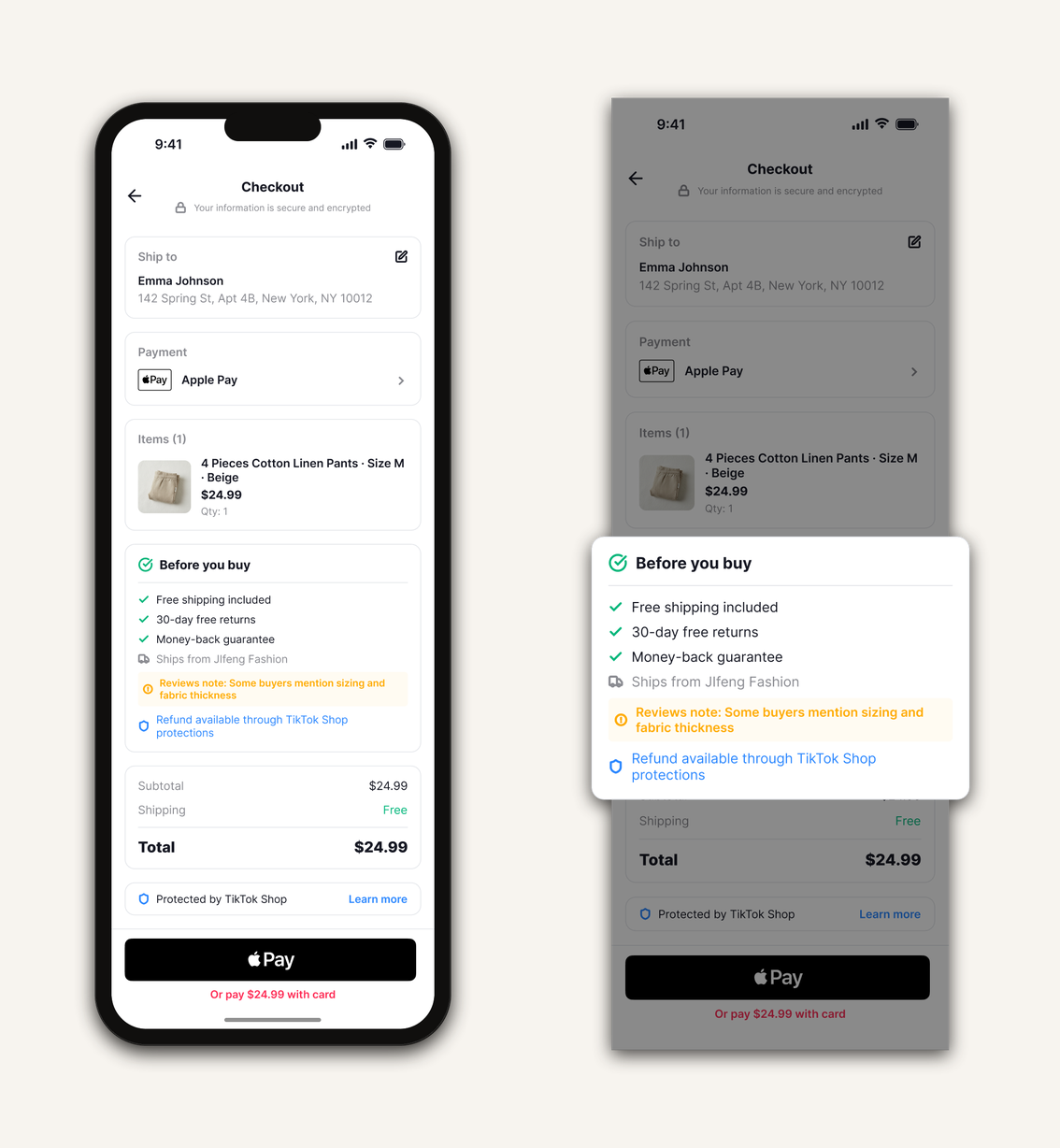
Add a “Before you buy” confidence panel specific to the current order.
05Post-Purchase
What exists now
Delivery status, return eligibility, review prompt, TikTok Shop survey, protections, refund support.
Trust gap
Generic satisfaction questions do not capture whether the delivered product matched the creator video that influenced the purchase.
Design opportunity
Add product-video match feedback after delivery.
Key teardown insight
This teardown changed the framing of the project: TikTok Shop already has trust infrastructure. The opportunity is not creation — it is synthesis.
TikTok Shop already invests in enforcement at scale — rejecting more than 70M product listings and removing 700K+ sellers in H1 2025. Source: TikTok Shop Safety Report.
Teardown captures
01 Discovery
02 PDP
03 Reviews
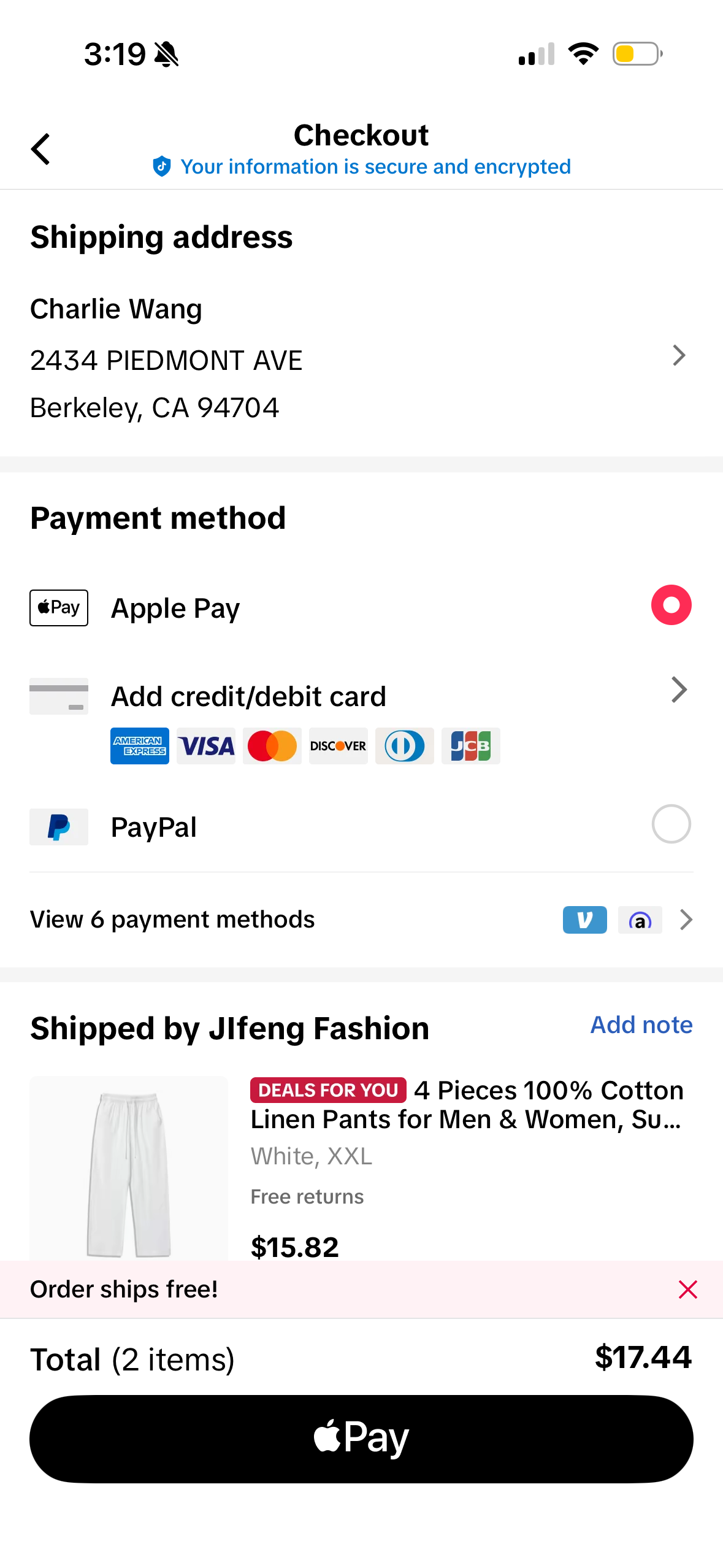
04 Checkout
03 — Trust System
From Scattered Signals to Buyer Confidence
The Trust Layer is not a new shopping flow. It is an information architecture layer that reorganizes trust signals around moments of hesitation.
Reviews
Seller status
Return policy
Shipping info
Creator disclosure
Product detail data
Checkout protections
Post-purchase feedback
→
Summarize
Prioritize
Contextualize
Flag concerns
Connect evidence to decision moments
→
Video Trust Preview
Buyer Confidence
Review Summary
Recommendation Context
Checkout Confidence
Post-Purchase Match Feedback
→
Faster evaluation
More informed purchases
Lower regret risk
Better feedback data
Stronger creator-commerce trust
AI Product Judgment
AI should summarize evidence, not decide for the shopper.
AI is useful for
✓Review pattern summarization
✓Concern clustering
✓Product fit summaries
✓Seller reliability synthesis
✓Product-video match feedback aggregation
✓Surfacing repeated buyer concerns
AI should not
—Tell users what to buy
—Hide negative information
—Overstate confidence
—Summarize when there is not enough review data
—Create opaque trust scores
—Punish small creators or new sellers unfairly
AI guardrails — every output should be
Labeled
Source-aware
Balanced
Traceable to evidence
Honest about limitations
“The strongest AI feature is not the summary itself. It is the discipline around when not to summarize.”
If there are not enough reviews or product signals, the system should say “Limited data available” instead of producing a false-confidence summary.
AI copy guidance
Say“Review summary based on 248 verified buyer reviews.”
Avoid“AI recommends this product.”
Say“Limited data — not enough reviews to summarize reliably.”
Avoid“Trusted by AI.”
Say“Common concern: sizing runs small.”
AvoidBlack-box scores without explanation.
04 — Experience
Six screens. Six moments of hesitation.
Each screen targets one buyer question surfaced by the teardown — the existing TikTok experience on one side, the Trust Layer feature designed for that moment on the other.
01Is this product worth opening?
Video Trust Preview
A lightweight confidence preview surfaced directly on the For You Page, before the buyer ever leaves the video.
ProblemA creator video creates desire before the buyer sees any evidence the product is worth opening.
SolutionSurface rating, returns, and seller status in a lightweight preview, without interrupting the video.
Why it mattersThe first shopping surface should preview whether a product is worth evaluating — not only create interest.
02Can I trust this product page?
Product Detail Buyer Confidence
A single module that synthesizes product, seller, shipping, and review signals on the product page.
ProblemTrust signals exist on the product page, but they’re scattered across separate sections.
SolutionA Buyer Confidence module summarizes traction, reliability, fulfillment, and known concerns in one place.
Why it mattersThe opportunity isn’t more information — it’s organizing what already exists into confidence.
03What do reviews actually say?
AI Review Summary Upgrade
An upgraded review summary that surfaces patterns, not just star ratings.
ProblemBuyers shouldn’t have to read dozens of reviews to understand what people actually think.
SolutionSummarize what people like, what they mention, who it’s best for, and what to watch out for.
Why it mattersAI should summarize evidence, not make the decision for the shopper.
04Why should I trust this recommendation?
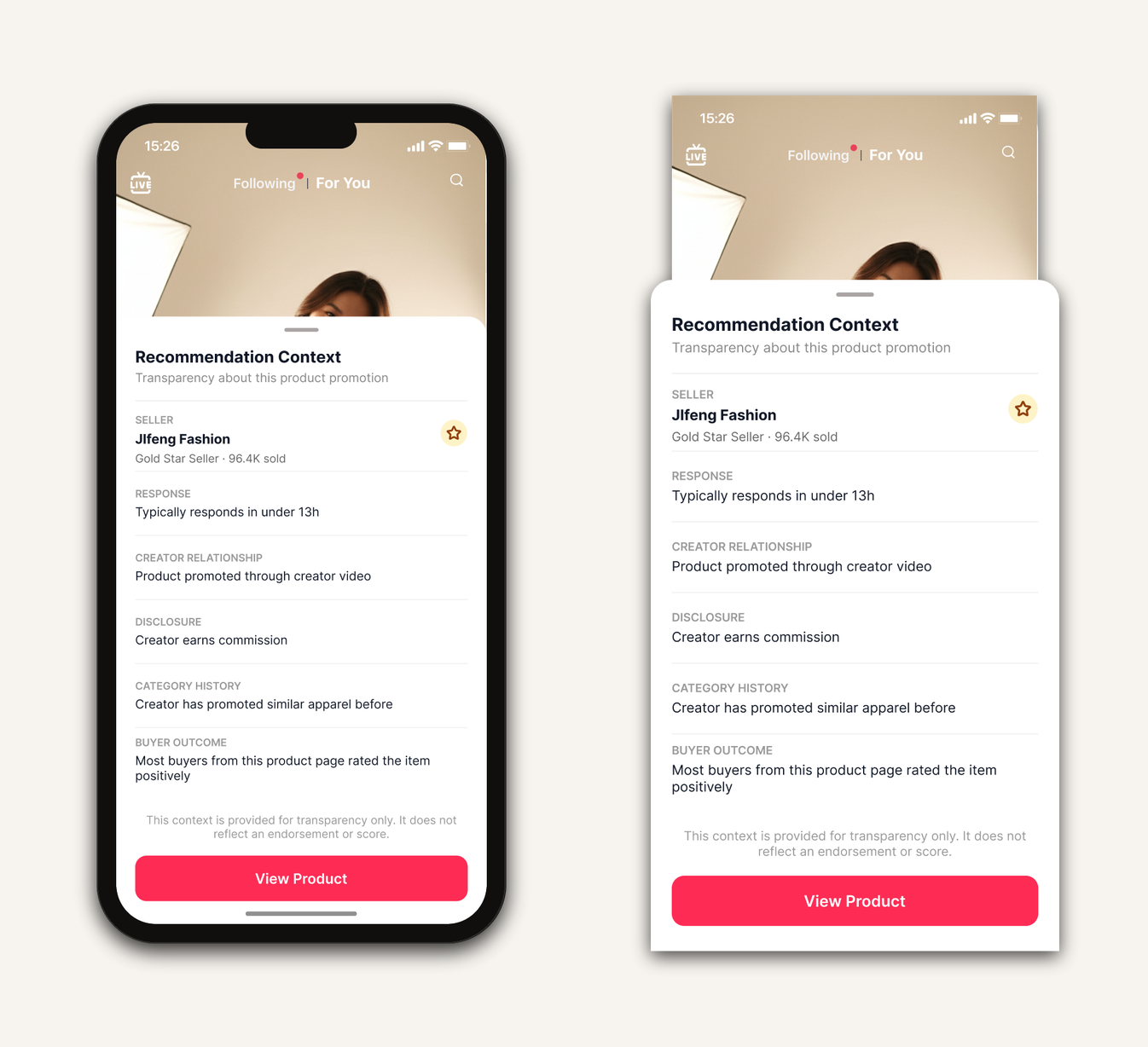
Recommendation Context
An optional bottom sheet that connects product, seller, and creator signals in one place.
ProblemBuyers don’t know how transparent a creator’s product recommendation actually is.
SolutionSurface seller response time, creator relationship, disclosure, and category history on request.
Why it mattersCreator credibility should be framed as context, not judgment.
05What protects this order before I pay?
Checkout Confidence Panel
A “Before you buy” panel that reassures the buyer with order-specific protections.
ProblemShipping and return protections read like generic policy, not reassurance for this order.
SolutionSummarize free shipping, returns, money-back guarantee, and refund recourse before payment.
Why it mattersGood commerce design should reduce regret, not just increase conversion.
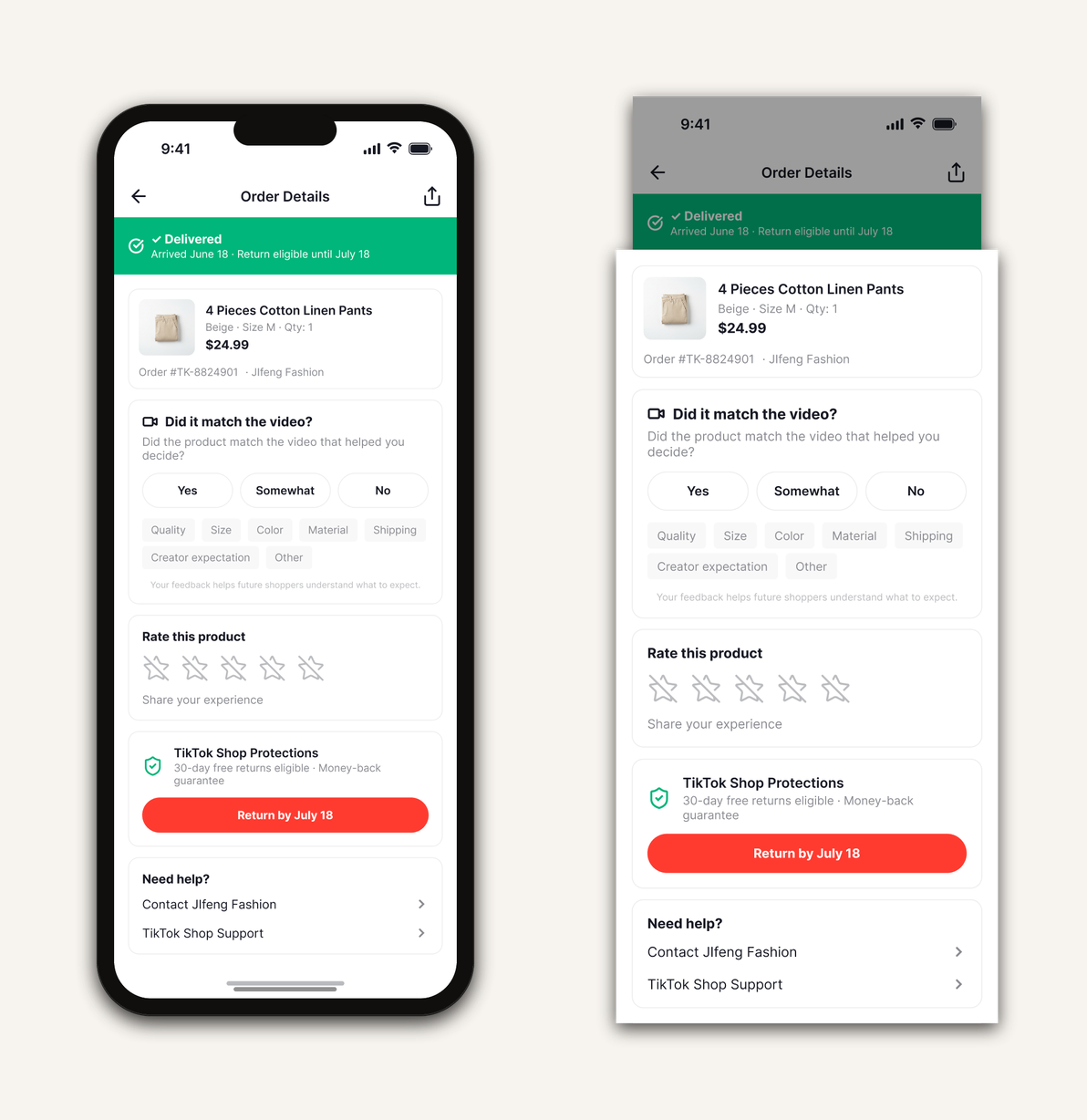
06Did the product match the video after delivery?
Post-Purchase Match Feedback
A lightweight feedback card that asks whether the product matched the video that sold it.
ProblemGeneric satisfaction surveys don’t capture whether the product matched the video that influenced the purchase.
SolutionAsk if it matched the video, then collect quick reason chips like quality, size, and material.
Why it mattersThe trust layer doesn’t end at checkout — post-purchase feedback improves future decisions.
Reflection
This started as a trust feature idea. It became a systems problem.
The teardown showed that TikTok Shop already has many trust features — ratings, reviews, seller badges, protections, refund support, post-purchase surveys. The issue was never absence. It was fragmentation.
Designing the Trust Layer required thinking across discovery, evaluation, creator transparency, AI synthesis, checkout confidence, post-purchase feedback, and marketplace health — not just six screens.
In creator commerce, the product is not the only thing being evaluated. The shopper is also evaluating the seller, the creator, the platform, and the gap between what was shown and what arrives.
The Trust Layer does not redesign TikTok Shop.
It reorganizes confidence around the moments buyers need it most.
Recruiter takeaway
This project demonstrates company-scale product thinking: diagnosing a platform-level trust problem, designing an additive system, applying AI responsibly, and connecting interface decisions to marketplace outcomes.
05 — Metrics
How I would measure success.
This project does not claim measured outcomes. These are the metrics I would track if it shipped — framed as proposed measurement, not results.
North Star Metric — Confident Purchase Rate
The percentage of completed purchases followed by no return, no dispute, and positive post-purchase feedback within 30 days. This focuses the product on purchase quality, not just conversion volume.
Input Metrics
- Trust card expand rate
- Review summary engagement
- Creator context taps
- Return policy views
- Checkout confidence panel views
Conversion Metrics
- Product detail to checkout conversion
- Checkout completion rate
- Add-to-cart rate
- Save-for-later rate
Quality Metrics
- Regret-driven return rate
- Product mismatch reports
- “Matched the video” feedback rate
- Review helpfulness
- Seller issue reports
Marketplace Health Metrics
- Repeat purchase rate
- Customer support contacts per order
- Seller reliability distribution
- Creator-driven return rate
Guardrail Metrics
- Conversion drop from too much friction
- AI summary distrust
- False trust warnings
- Seller or creator fairness concerns
The goal is not simply to increase conversion. The stronger outcome is confident conversion: purchases that buyers still feel good about after delivery.